






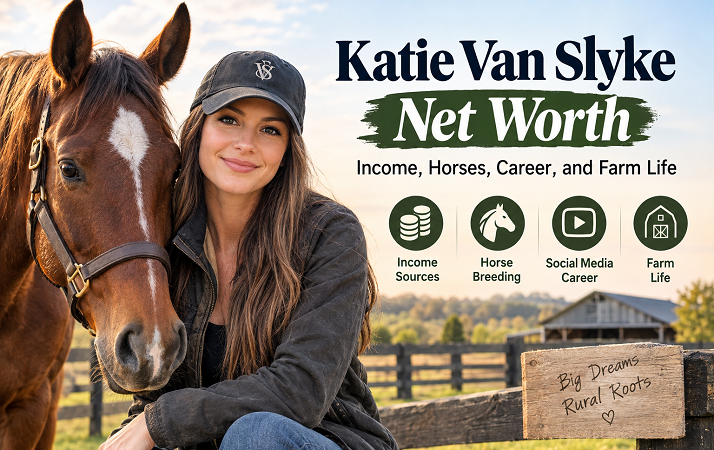
Katie Van Slyke has built a recognizable name by sharing her passion for horses, farm animals, and outdoor living. What started as a personal interest in documenting life around animals has grown into a substantial online presence. Today, her content attracts viewers who enjoy rural living, equestrian activities, and the realities of running a farm.
Her growing popularity has also sparked curiosity about her finances. Many fans want to know how much Katie Van Slyke is worth, where her money comes from, and how her horse-breeding business contributes to her success.
As of October 2026, online estimates commonly place Katie Van Slyke’s net worth between $4 million and $6 million. However, she has not publicly confirmed this amount, and no independently verified financial statement establishes her total wealth. These figures should be viewed as estimates, not confirmed financial facts.
Her financial story extends beyond social media. Katie combines content creation with horse breeding and other farm-related activities, creating several potential sources of income. Understanding her wealth requires looking at those businesses, their earning potential, and the costs involved.
Katie Van Slyke Net Worth in 2026
Katie Van Slyke’s estimated net worth has attracted considerable attention as her online audience has grown. Several websites publish figures in the $4 million to $6 million range, although estimates vary and their calculations are not always transparent.
Without verified information about her income, debts, business ownership, and assets, an exact valuation remains impossible.
Her financial position likely reflects several factors, including social media earnings, commercial partnerships, horse-breeding activities, and other business ventures. However, gross revenue and personal wealth are two different things.
For example, a horse may have significant market value, but its owner must still pay for feed, veterinary care, training, and routine maintenance. Similarly, a creator may earn substantial advertising revenue while facing business expenses, taxes, and production costs.
These distinctions matter when evaluating any public figure’s finances.
Katie Van Slyke’s financial profile at a glance
| Category | Details |
|---|---|
| Estimated net worth | Common online estimates range from $4 million to $6 million |
| Verified net worth | Not publicly confirmed |
| Profession | Social media creator and horse breeder |
| Primary location | Tennessee, United States |
| Main content | Horses, farm life, animal care, and outdoor activities |
| Official website | katievanslyke.net |
The estimated range provides a general picture of her reported wealth, but it should not be mistaken for an audited financial assessment.
Who Is Katie Van Slyke?
Katie Van Slyke is an American content creator and equestrian known for documenting her experiences with horses, livestock, and rural life. Her videos offer a look at the daily responsibilities of caring for animals, managing breeding activities, and maintaining a farm.
Unlike influencers whose content centers primarily on fashion or luxury, Katie focuses on a specialized interest. Her audience follows the animals, breeding updates, and everyday moments that make up her life on the farm.
Her official website highlights her horse-breeding journey and the development of her online presence.
Early life and interest in horses
Katie grew up around horses and farm animals in Tennessee. Her familiarity with rural life helped shape the content she would eventually share online.
Over time, she began posting photographs and videos about her interests. Those early posts connected her with people who shared her enthusiasm for horses and equestrian activities.
Katie has identified April 27, 2017, as a turning point in her journey. An Instagram post helped direct her attention toward horse breeding and content creation.
As her interests developed, she began sharing more about the breeding process, animal care, and the realities of farm life. This approach gave followers a reason to return for updates rather than simply watch individual videos.
How she built her audience
Katie’s popularity grew through consistent content about horses, livestock, hunting, and outdoor adventures. Her videos appeal to experienced horse owners, aspiring equestrians, and viewers who simply enjoy country living.
The appeal comes partly from the subject matter. Horse breeding and farm management involve real work, unexpected developments, and long-term commitments. Sharing those experiences gives viewers a more personal understanding of the lifestyle.
As her audience expanded, her online presence created opportunities for commercial partnerships and other business activities. Social media became more than a place to share personal experiences; it became an important part of her professional brand.
How Does Katie Van Slyke Make Money?
Katie has several potential revenue streams connected to her online presence and equestrian activities. However, she has not publicly disclosed a complete breakdown of her personal earnings.
The following sources help explain the business model behind her career.
1. Social media earnings
Social media is one of the most visible parts of Katie’s career. She shares content across platforms such as TikTok, Instagram, YouTube, and Facebook.
Depending on platform rules and account eligibility, creators may earn money through advertising, video monetization programs, and other revenue-sharing arrangements.
Audience size can help, but it does not tell the whole story. Earnings depend on factors such as video views, engagement, audience location, content format, and the monetization options available to each account.
Katie also benefits from having a subject that naturally produces fresh material. Foaling season, horse development, animal care, and daily farm routines can all become new stories.
This variety gives her opportunities to publish short clips alongside longer updates. Still, there is no reliable public figure for her total earnings from social media.
2. Brand partnerships and sponsorships
Companies often work with creators whose audiences align with their products. Katie’s focus on horses, hunting, and outdoor activities makes her a natural fit for certain equestrian and sporting markets.
Her content has been associated in third-party reports with outdoor and sporting brands, including Realtree, Bowtech, and Smith & Wesson. However, public information does not establish the current terms or financial value of every reported relationship.
Sponsorship arrangements can take several forms. A company might pay for a single post, commission a series of videos, or establish a longer-term partnership.
The amount depends on the agreement, the creator’s reach, audience engagement, and the work required. Without access to the contracts, assigning a specific dollar value to Katie’s sponsorship income would be speculative.
3. Horse breeding and equestrian activities
Horse breeding is a central part of Katie’s public identity and business activities.
Through Running Springs, she shares her involvement with American Quarter Horses and the work involved in breeding and raising them. Her website also discusses the development of her breeding program.
A breeding operation may generate revenue through several activities:
- Breeding fees: Owners may charge for approved breeding services.
- Horse sales: Depending on ownership and business arrangements, horses may be sold to buyers.
- Bloodline value: Desirable pedigrees can increase a horse’s commercial appeal.
- Related services: Some equestrian businesses offer additional services or products connected with their operations.
However, breeding horses is expensive and unpredictable. Veterinary examinations, reproductive care, feed, training, transportation, and facility maintenance can consume a substantial portion of revenue.
A horse may also require years of investment before producing a financial return. Its market value depends on factors such as pedigree, health, training, performance, and buyer demand.
For that reason, the value of a breeding operation cannot be measured simply by counting its horses. Profitability depends on the relationship between revenue, operating costs, and the long-term value of its assets.
4. Merchandise and branded products
Merchandise offers creators another way to connect with their audiences. Fans may purchase clothing, accessories, or other products associated with a personality they follow.
Katie’s official website provides information about her brand and related offerings. However, publicly available information does not establish how much she earns from merchandise.
Sales also do not equal profit. Product manufacturing, shipping, payment processing, marketing, and customer service all create expenses.
Even so, merchandise can complement an established online presence. It gives followers another way to engage with a brand while creating a potential revenue stream beyond advertising.
5. Farm and agricultural activities
Katie’s content features horses, cattle, and other farm animals. Depending on the ownership structure and specific operations, agricultural activities may create additional business opportunities.
Livestock can have commercial value, while breeding and related farm services may generate revenue. Property, equipment, and other business assets may also contribute to an operation’s overall value.
However, it would be misleading to assume that every farm activity produces a profit.
Feed prices can fluctuate, animals may require unexpected medical treatment, and agricultural markets can change. Weather and other operational challenges may also affect results.
It is equally important to distinguish personal assets from property or equipment owned by a family farm or business. Public information does not establish the exact ownership arrangements across all of Katie’s activities.
Katie Van Slyke’s Income Sources Compared
The following comparison explains how her different activities may contribute to her business. It is not a verified breakdown of her personal income.
| Income source | Potential revenue | Main financial consideration |
|---|---|---|
| Social media | Advertising and eligible platform payouts | Views, engagement, and platform rules |
| Brand partnerships | Sponsored posts and campaigns | Contract terms and audience relevance |
| Horse breeding | Breeding fees and potential horse sales | Veterinary and operating costs |
| Merchandise | Branded product sales | Production and fulfillment expenses |
| Agricultural activities | Livestock and farm-related revenue | Feed, labor, and market conditions |
The main advantage of this approach is diversification. A creator with several connected business activities may have more opportunities than someone who depends entirely on one social media platform.
However, multiple revenue streams also require careful management. Each business has its own expenses, risks, and demands on time.
How Katie Van Slyke Turned Farm Life Into a Business
Katie’s career illustrates how practical experience and a specialized interest can become the foundation of a recognizable brand.
Her advantage is not simply her ability to publish videos. Her involvement with horses and farm animals gives her a continuing source of material that reflects real experiences.
Several factors help explain why this approach can work.
Authenticity and practical experience
Katie’s content shows the work behind animal care and horse breeding. Viewers can follow developments over time and see the responsibilities that come with raising animals.
That perspective gives her videos practical relevance. People interested in horses may learn about breeding, foaling, animal behavior, and everyday care.
Creators who understand their subjects can often provide more useful content than those who rely entirely on trends.
A clearly defined niche
A specific focus can help a creator stand out in a crowded market. Katie’s emphasis on horses, farm life, and outdoor activities gives her brand a recognizable identity.
That specialization can also attract commercially relevant audiences. Businesses selling equestrian equipment, animal-care products, and outdoor gear may find those viewers particularly valuable.
Stories that develop over time
Farm life offers plenty of ongoing stories. A breeding season, a new foal, a horse’s training progress, or a change in farm routines can provide material for multiple updates.
These developments encourage viewers to follow along. They also create opportunities for short-form videos, longer educational content, and regular updates.
Connecting online content with real-world activities
Katie’s career shows how digital content can support an existing interest or business.
Farm activities provide material for her videos, while social media introduces those activities to a broader audience. That visibility may create opportunities to reach customers, build commercial relationships, and strengthen brand recognition.
The connection between online storytelling and real-world work is a key part of understanding her business model.
Pros and Cons of Katie Van Slyke’s Business Model
Katie’s career combines the reach of digital media with the responsibilities of working around animals.
| Pros | Cons |
|---|---|
| Multiple potential revenue streams | Income can fluctuate |
| A clearly defined audience | Social media algorithms can change |
| Opportunities for brand partnerships | Sponsorships depend on demand and contract terms |
| Practical experience supports her content | Animal care requires ongoing spending |
| Farm activities provide fresh material | Breeding involves financial and health risks |
| A recognizable personal brand | Public visibility can affect privacy |
The model offers opportunities, but success requires more than consistent posting. Business planning, animal welfare, audience engagement, and expense management all play important roles.
Expert Tips: What Aspiring Creators Can Learn From Katie Van Slyke
Katie’s career offers useful lessons for people who want to turn a personal interest into a sustainable business.
1. Choose a subject you genuinely understand
Practical knowledge gives content more depth. A creator who understands a subject can explain its challenges, answer common questions, and share useful experiences.
Start with an interest you can discuss accurately and consistently.
2. Give your audience a reason to return
Ongoing stories encourage repeat viewing. A gardener, for example, can document a plant from seed to harvest rather than publish unrelated videos.
The same approach works for animal care, crafts, cooking, and educational content. Progress gives viewers something to follow.
3. Build an audience before relying on the income
A growing follower count does not guarantee a dependable salary. Platform policies, audience engagement, and advertiser demand can all affect earnings.
Focus first on creating useful content and understanding your audience. Treat monetization as a business process rather than an automatic reward for gaining followers.
4. Diversify without overextending yourself
Advertising, sponsorships, merchandise, and services can complement one another. However, launching too many ventures at once can create unnecessary costs and distractions.
Build on proven demand. Expand when the numbers support the decision.
5. Measure profit, not just revenue
Revenue tells you how much money comes in. Profit shows what remains after expenses.
Creators should account for taxes, equipment, contractors, production costs, and other business obligations. Farm operators must also budget for animal care, maintenance, and unexpected expenses.
Understanding these figures provides a much clearer view of financial health than views or sales alone.
(FAQs) About katie van slyke net worth
1. What is Katie Van Slyke’s net worth in 2026?
Online estimates commonly place Katie Van Slyke’s net worth between $4 million and $6 million. She has not publicly confirmed that figure, so it should be treated as an estimate rather than a verified valuation.
2. How does Katie Van Slyke make her money?
Her potential income sources include social media monetization, brand partnerships, horse breeding, merchandise, and farm-related activities. Her exact earnings from each source remain private.
3. Is Katie Van Slyke a professional horse breeder?
Yes. Katie is involved in American Quarter Horse breeding through Running Springs. She also shares content about horses, breeding activities, and farm life.
4. Where does Katie Van Slyke live?
Public profiles associate Katie with Tennessee, where her content features horses, livestock, and rural living. Her videos regularly document the animals and routines connected with her farm activities.
5. Who is Katie Van Slyke’s husband?
Katie is married to Jonathan Mabry. Public reports describe his involvement in construction and farm-related activities, but the couple’s complete financial arrangements have not been publicly established.
6. Does Katie Van Slyke earn money from TikTok?
TikTok offers eligible creators monetization opportunities under its current program rules. Katie uses social media to share content and develop her brand, but her exact TikTok earnings have not been independently verified.
7. Does Katie Van Slyke own valuable horses?
Katie participates in Quarter Horse breeding and regularly discusses her horses. Individual horses can have considerable commercial value, but their current market prices and their contribution to her personal wealth are not publicly established.
8. Does Katie Van Slyke make money from Instagram?
Instagram can provide income opportunities through sponsorships, partnerships, and eligible monetization features. Although third-party websites publish estimates, Katie’s actual Instagram income remains unknown.
9. Is Katie Van Slyke’s net worth officially confirmed?
No publicly verified financial statement establishes her total net worth. Online estimates rely on assumptions about income, assets, and business activities, which may not reflect her actual financial position.
10. Why is Katie Van Slyke so popular?
Her popularity comes from a combination of horse breeding, practical farm experience, animal-focused storytelling, and outdoor content. Her videos give viewers an ongoing look at a specialized lifestyle and the work behind it.
Conclusion: katie van slyke net worth
Katie Van Slyke’s net worth has become a popular topic as her online presence and horse-breeding activities have attracted a wider audience.
Some online reports estimate her wealth at $4 million to $6 million, but no publicly confirmed figure establishes her actual financial position. Her income, expenses, business assets, debts, and ownership arrangements remain largely private.
Her career nevertheless offers a compelling example of how a specialized interest can support a broader business. Horse breeding provides real-world experience, while social media helps her share that experience with a large audience. Sponsorships and other commercial opportunities may create additional revenue.
At the same time, running a farm and caring for animals involves substantial costs and unpredictable challenges. A realistic assessment must account for those responsibilities rather than focus only on online popularity.
Ultimately, Katie’s business story extends beyond follower counts. Her combination of practical knowledge, consistent content, and equestrian activities helps explain her growing profile in the rural lifestyle and horse-breeding communities. Her exact net worth remains uncertain, but the business model behind her success offers useful lessons for aspiring creators and entrepreneurs.